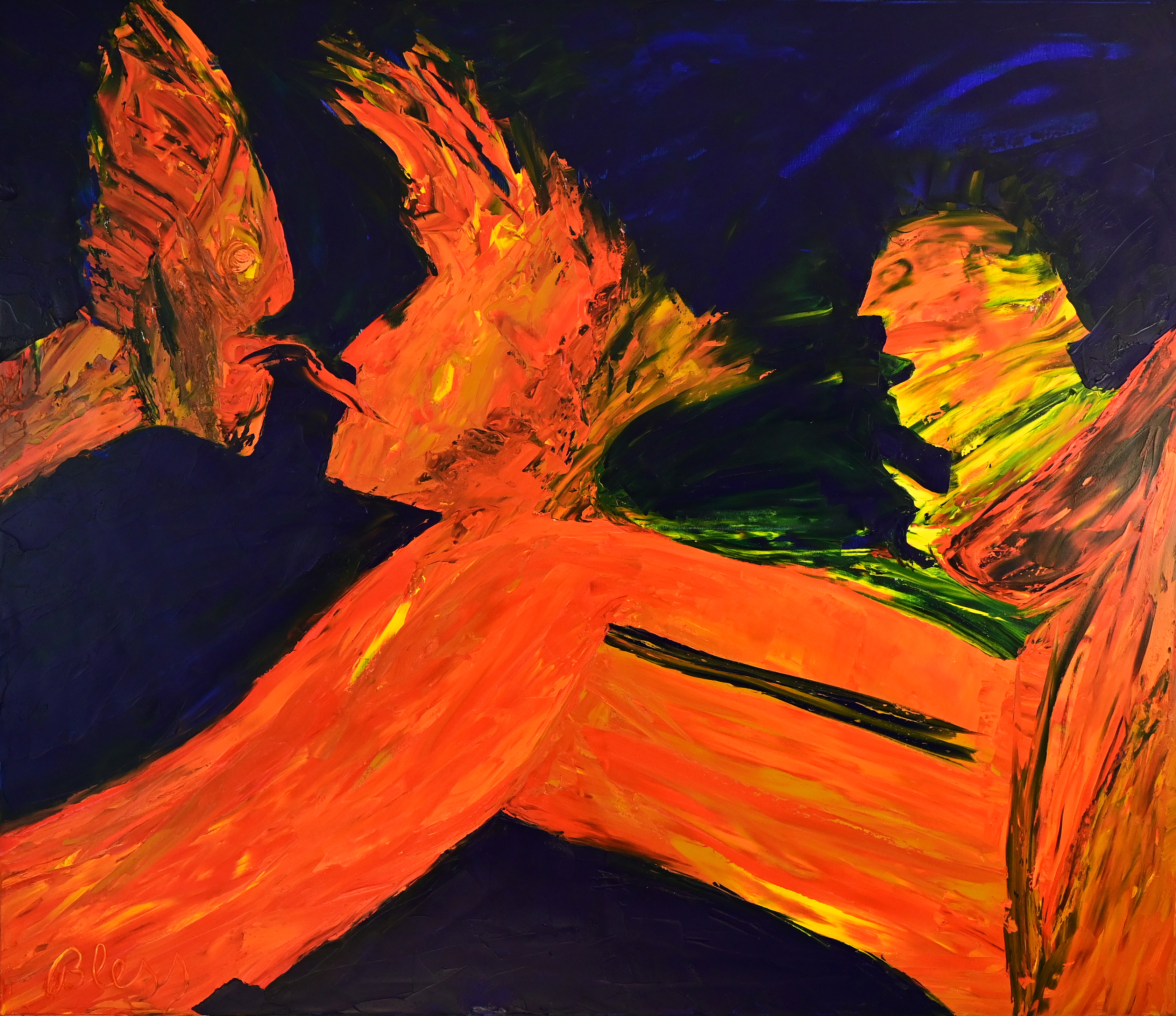
The accusing witness speaks about one of the oldest forms of human violence: the need to condemn what we cannot understand. At the center of the work is a lively, almost organic exchange between two presences that seem to transfer not only fluids but also vulnerability, energy, and truth. However, on the right side appears the familiar figure of the one who does not participate in life but judges it from a distance.
The accuser does not seek the truth. He seeks the moral control he gains when he finds a fault. He does not look at the depth of the gesture but at the superficiality that can be condemned. Therefore, the person who points a finger is never spiritually cleaner than those he accuses; he is merely emptier and more frightened.
The work proposes an uncomfortable idea: sometimes, those who condemn the most the intimacy, freedom, or authenticity of others are precisely those who are incapable of living those things in their own interior. Judgment thus becomes a mask of frustration, and accusation—a desperate attempt to transform one's own lack into moral superiority.
In a society obsessed with finding "a flaw in the tapestry," "The Accusing Witness" is not just a character. It is a mirror. Because every person risks, at some point, becoming the sterile spectator of others' lives, confusing observation with truth and criticism with wisdom.
But the profound truth remains simple: what is alive will always be judged by what has ceased to feel.
The Accuser.